Sometime in July, when the world was going through another set of geopolitical challenges, the question of where to spend Diwali came up at home. The best part about having a large bucket list and a toddler who likes to travel is the ability to visit just about any place, all options weighed, it was time to visit South Korea. The 9 day plan had some must-have’s with TD (The Daughter) wanting to try some exotic sea food, TW (The Wife) wanting to try some Korean food and me wanting to add airlines, airports and view North Korea.
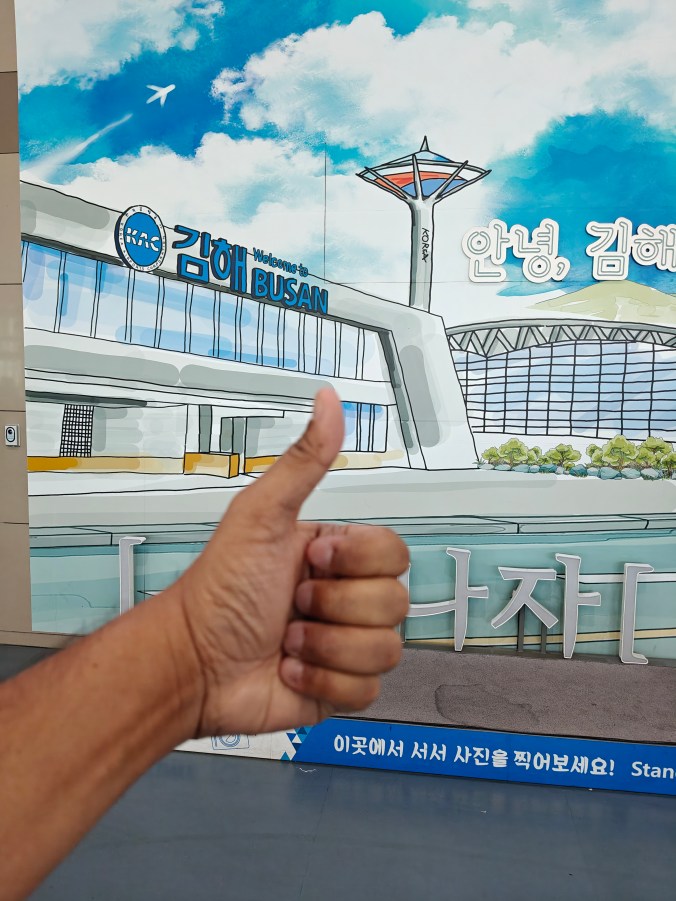
The final routing and cities, Mumbai – Hong Kong – Seoul Incheon on Cathay Pacific, seeing a new airline and two new airports for me; Seoul Gimpo to Busan on Air Busan, a new airline and two new airports; Busan – Hong Kong – Mumbai on HK Express + Cathay Pacific, giving a new airline. This combination would give me my 100th airport, in the form of Busan, a military airbase where photography is not permitted. Luckily, there is a photo spot within the terminal where I could click a picture to celebrate the occasion.
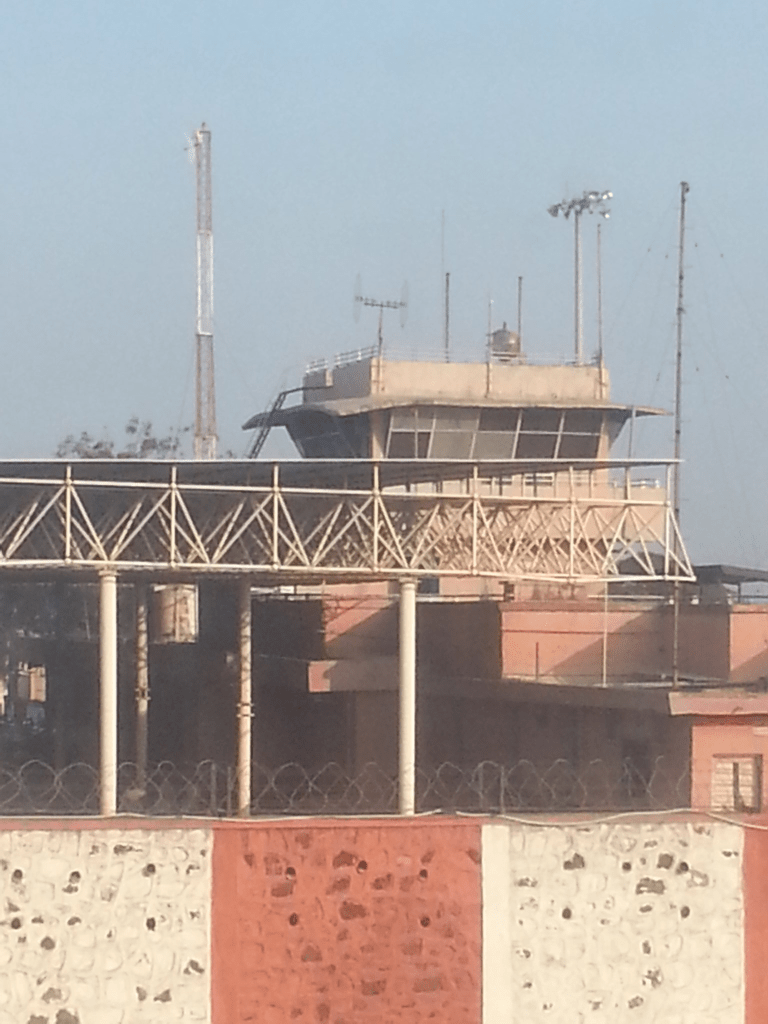
My first flight was a few days before I turned two years old. A family friend who worked for Indian Airlines informed my parents that it would be a great idea to fly from Aurangabad (IATA:IXU) to Mumbai (IATA:BOM) before I turned two since the fare is only 10% for infants. My parents paid 21 rupees for my ticket, which definitely was a large sum in the late 80s. Here is the image of Aurangabad airport’s old and now defunct airport which I clicked a few years ago, with that of Busan below it.
Trip Summary
- Airline: Air Busan (IATA: BX, ICAO:ABL, Call Sign: Air Busan)
- Route: Seoul Gimpo to Busan
- Flight Number: BX 8821
- Registration: HL8055
- STD: 1640, ATD: 1640
- ETA: 1745, ATA: 1738
Booking & Pricing
While the friendly travel agent booked the Cathay Pacific flights, the internal flight between Seoul and Busan was booked much later as we kept debating if we want to visit Busan or Jeju, with both not being possible in the time we had. In the end, it was Busan with two options available to fly at the desired time. Korean Air with the A220s and Air Busan with the A320ceo. Korean Air was nearly 2x in pricing as compared to Air Busan. WIth both carriers being new to me, the cost angle triumphed and Air Busan it was. Booking was done on the Air Busan website, including purchase of seats and paid seamlessly via Indian credit card. The tickets were in the inbox in no time. Add-ons were advertised but not available for purchase, possibly because of the short flight.
We selected row 2 for the journey (paid selection). The fare came up to around INR 2500 per person for this 45 minute flight. This included a 15 kg check-in baggage allowance per passenger. Air Busan is owned by Asiana Airlines and with Asiana merging with Korean Air, days look numbered for Air Busan, making it a rare carrier in the list of airlines I have flown.
A couple of days to departure from India, I tried the online check-in and it worked perfectly. So we had three boarding passes with us, with everything but the name written in Korean. A quick scan from Google Translate confirmed that everything was correct.
Airport Experience
Seoul has two civil airports, Incheon which opened in 2001 and Gimpo (IATA: GMP) which was built during the second world war and continues to operate both domestic and international flights, including widebody aircraft. Gimpo would be my 99th airport. We took a taxi from the city centre to Gimpo, which took about 45 minutes in the afternoon and walked to the Air Busan counters only to be told to wait for a few minutes as our flight was not yet open for check-in. There was extra focus on power banks, which wasn’t surprising with the airline having had to write-off a plane early this year due to a fire suspected to have originated due to a power bank. We roamed around the airport looking at all the airport counters. While Korea continues to live in 2050, the baggage weighing machines kept for use by passengers at the airport were faulty, with one showing -3.5 kgs.

Check-in started and we quickly made our way to the queue. There was a separate section where we observed a few people waiting post handing over bags at the counter. It was an interesting concept. At the counter, we were asked if there are any power banks which we have checked in. We were also asked if we have a local number, the answer for which was negative. We were asked to wait at the designated place for 5 minutes until the bags were cleared by security.

With the inline baggage system, the bags went ahead but the passengers without a local number to contact were made to wait in the corner. The clearance came and we headed to the floor above for security, which was separate for Korean nationals and foreigners. For foreigners, there was a check of identity (passport) after which the line opened up to a security section. Koreans had an option of automated gates leading up to security. The security across airports outside India, in this trip, has been seamless with electronic devices inside the bag, not needing to remove belts or shoes and passing through a Full body scanner at airports. Gimpo was no different and on the other side there was exactly one food court, along with gates on both sides with long walks and walkators.
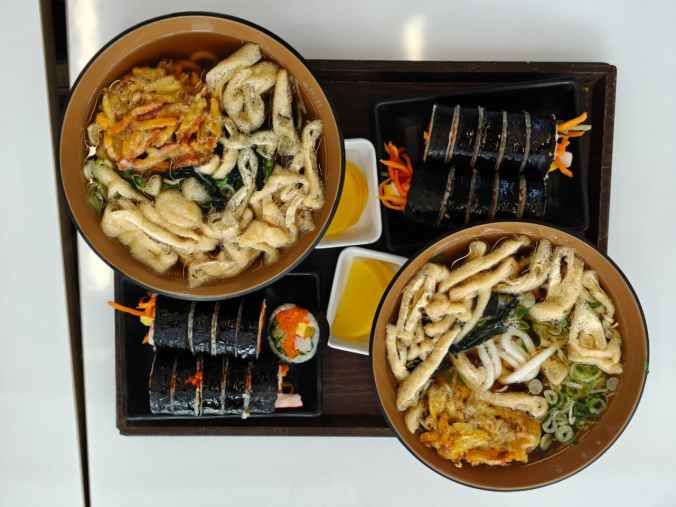
Our gate for the day was #3, on the far left while facing the runway. We had a hearty tasty Korean meal before making our way to the gate.
At the gate, the crowd was building up. It was 1600 and Korean Air to Busan was delayed by 10 mins, with no signs of boarding for Air Busan 8821 scheduled for 1640. At 1611, Korean Air closed boarding and the beautiful A220 pushed back. Air Busan staff went around confirming there are no power banks and tagging each bag with a sticker.

A crowd had started building up, in what looked like a shuttle flight back to Busan after a day’s work in Seoul for most. At 1620, boarding was announced and a very orderly line formed for boarding. Over 170 on board this 180 seater aircraft and orderly boarding was done in 11 minutes, with a pushback commencing exactly at 1640 hours.
Aircraft and Cabin
The aircraft was spotlessly clean with clean windows. Having pushed back on time, it was a short taxi to the threshold of runway Three Two L before a powerful takeoff, banking left and turning to set course for Busan. There was a magazine and safety card along with air sickness bag. The short taxi time was the time taken by the crew to do the safety demo, in Korean and Engish.
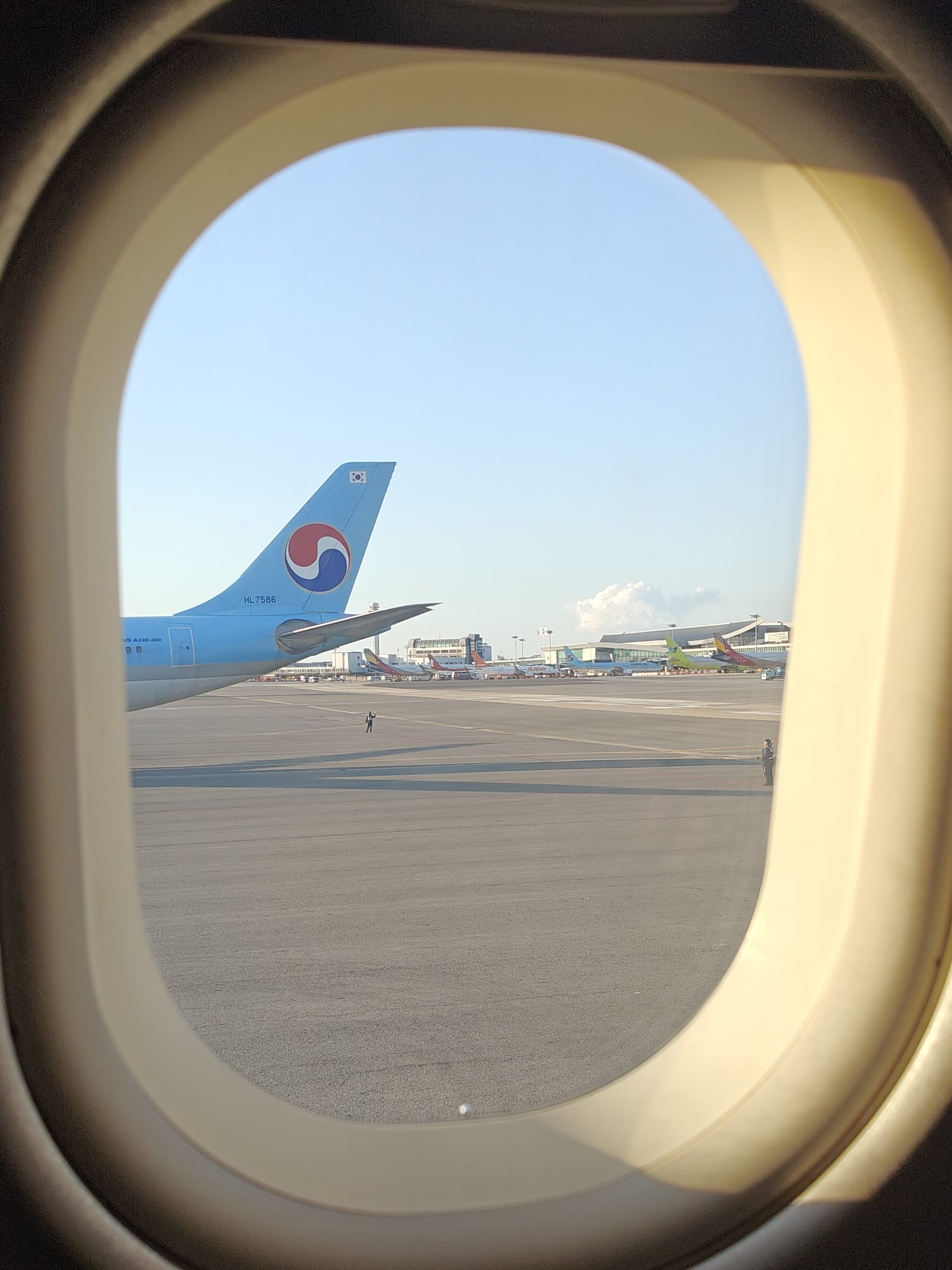


The aircraft was at cruising altitude was just over 10 minutes before we descended into Busan, with a set of twists and turns giving us a nice glimpse of the ocean, ships, rocks before landing on runway three six R at Busan, my 100th airport. There was no service whatsoever during the flight. We were in row two and the seats had good padding for a low cost carrier. Passengers had kept their luggage in the overhead bins or under the seat in front. As we taxied to the gate there was a sudden clamour to get down, and while people stood up when the parked, the click click of removing seat belt was clearly missing till the aircraft came to a complete halt. Everyone started rushing out and the reason was known. Most of the aircraft had seen the massive traffic jam near the airport which was visible during landing.

Arrival Experience
Most of the passengers made a dash to the exit gates and their profile was well noticed at Gimpo, business travellers with one backpack returning back home. A handful, like us, made our way to the small baggage belt with the bags arriving in no time. The journey from the airport to the hotel was a tedious one, taking more time than what it took for the flight.
Summary
I will give Air Busan a thumbs up. The airline gave the vibe of Go Air. A similar Blue color as its brand color, simple operations, and same slogan. Air Busan’s marketing slogan is “Fly Smart” and if you think you have heard it before, it was the same which Go Air (later Go FIRST) had.
 ScoopTroopers